How to Get the 20 Kill Badge in Apex Legends
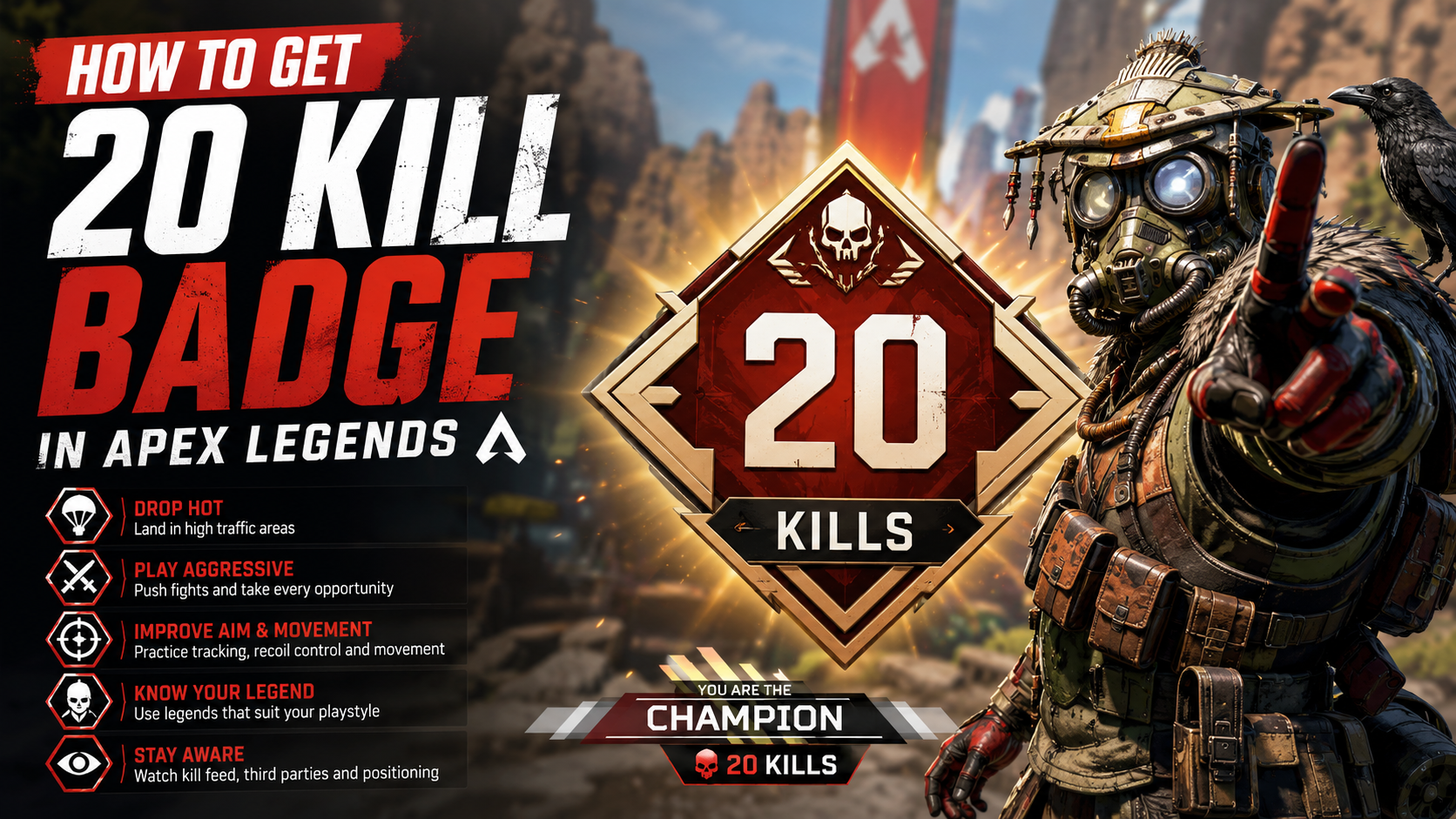
Many players spend hundreds of hours in Apex Legends chasing one elusive milestone: the 20 Kill badge. Despite consistent improvement in aim, movement, and game knowledge, the badge remains out of reach for the vast majority of the player base. The 20 Kill badge is a special combat award granted to any player who achieves twenty or more eliminations in a single match. It stands as one of the most prestigious indicators of individual skill within the game. This article will provide a complete breakdown of what the badge requires, which factors influence success, what strategies maximize kill counts, and how to avoid common pitfalls that prevent players from reaching this goal.
What Is the 20 Kill Badge in Apex Legends and Why It’s Hard
The 20 Kill badge represents one of the most difficult combat achievements in Apex Legends. It demands not only a high level of individual mechanical skill but also a favorable set of in-game circumstances that align perfectly over the course of a single match. The challenge stems from a combination of distinct factors. First, Apex Legends features a relatively high Time-to-Kill (TTK), meaning engagements last longer than in many other battle royale titles, giving opponents more opportunities to escape, heal, or receive help from teammates. Second, competition for kills is intense; every squad in the lobby is actively trying to eliminate others, making it difficult to secure a large share of the available eliminations. Third, the pace of the lobby itself plays a critical role — if teams play too passively and avoid combat, the number of available kills drops significantly. Finally, Random Number Generation (RNG) heavily influences outcomes. The distribution of enemy teams across the map, the early elimination of squads before you can engage them, and the timing of third-party opportunities are all outside any player's direct control. To earn this badge, a player must combine exceptional performance with a sequence of fortunate events.
Best Legends for 20 Kill Badge
Choosing the right Legend is a foundational decision when pursuing high kill games. Mobile and aggressive Legends provide the tools necessary to locate enemies quickly, close distances effectively, and survive chaotic engagements. Three Legends stand out as optimal choices for this objective.
Wraith offers one of the most reliable survival tools in the game. Her tactical ability, Into the Void, allows her to phase out of danger, reposition during fights, and escape situations that would eliminate other Legends. This makes her exceptionally strong for aggressive play because she can push into risky positions without facing immediate death. Her hitbox is also among the smallest, reducing the damage she takes in direct firefights.
Octane provides unmatched rotational speed. His Stim ability grants a significant movement speed boost at the cost of health, allowing him to traverse large sections of the map in seconds. His Jump Pad enables his entire team to clear obstacles and reposition rapidly. For the 20 Kill badge, speed is critical because kills must be secured before other teams eliminate each other or die to the ring. Octane ensures that a player can reach fights before they conclude.
Horizon brings exceptional vertical control and engagement manipulation. Her Gravity Lift lifts her and her teammates into the air, providing superior sightlines and the ability to shoot over cover. Her ultimate, Black Hole, pulls enemies into a tight cluster, creating opportunities for multi-kill grenade throws or concentrated fire. Both abilities create disarray among enemy teams, giving Horizon a distinct advantage in chaotic multi-team fights.
Best Weapons and Loadouts in Apex Legends
Weapon selection must support an aggressive, high-tempo playstyle oriented toward quick eliminations rather than prolonged exchanges. The most effective loadouts emphasize versatility, consistent damage output, and forgiving Time-to-Kill values that do not require perfect accuracy to secure kills.
A standard and highly effective pairing is an Assault Rifle (AR) combined with a Submachine Gun (SMG). The AR handles medium-range engagements, allowing a player to deal damage before closing distance, while the SMG covers close-range combat with high fire rates and manageable recoil. Weapons such as the R-301 Carbine and the Volt SMG exemplify this combination, offering stable recoil patterns, solid damage per magazine, and reliable performance across most combat scenarios. Alternatively, the Flatline paired with the R-99 provides higher raw damage output at the cost of more demanding recoil control. Prioritizing weapons with high ease of damage realization — meaning that landing hits does not require exceptional mechanical precision — reduces the risk of missing crucial eliminations during fast-paced fights.
Strategy: How to Get 20 Kills in Apex Legends
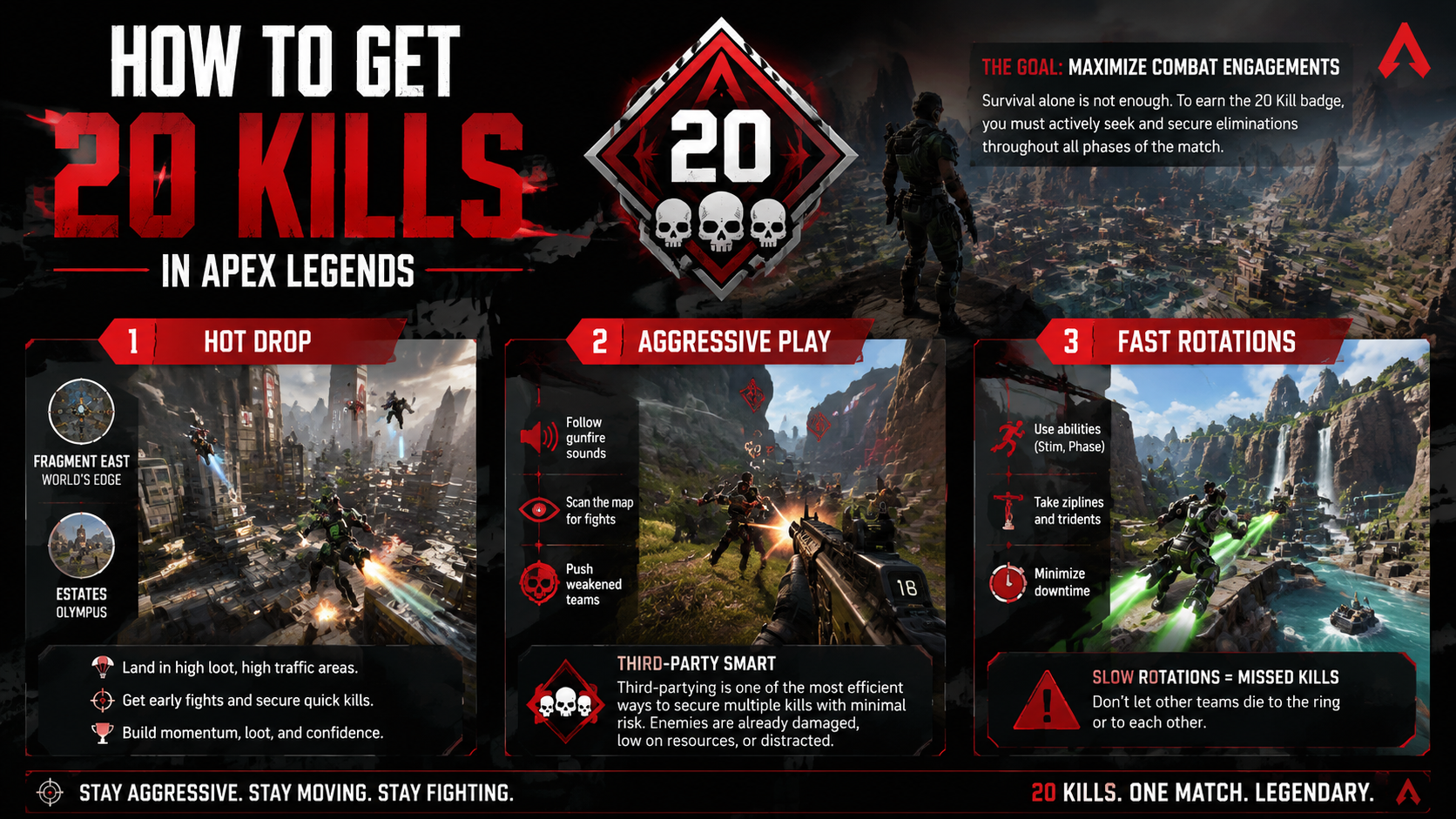
The central objective in pursuing the 20 Kill badge is to maximize the number of combat engagements a player participates in during a single match. Survival alone is insufficient; the player must actively seek and secure eliminations throughout all phases of the game. Three strategic principles govern successful high kill attempts.
The first principle is the hot drop. Landing in locations with high loot density and guaranteed early contact, such as Fragment East in World's Edge or Estates in Olympus, ensures immediate access to opponents. Early kills provide momentum, equipment, and the confidence needed to maintain an aggressive pace.
The second principle is aggressive play. After the initial drop, the player should not wait for fights to come to them. Instead, they must actively hunt for combat by moving toward gunfire sounds, scanning the map for markers indicating ongoing engagements, and pushing weakened teams that have recently fought. Third-partying — engaging a fight already in progress — is one of the most efficient ways to secure multiple kills with minimal risk because the opposing teams are already damaged, low on resources, or distracted.
The third principle is fast rotations. Between engagements, the player must move quickly and deliberately toward the next potential fight zone. Using Octane's Stim, Wraith's phase, or simply taking ziplines and tridents reduces downtime and keeps the player in active areas of the map. Slow rotations allow other teams to die to the ring or to each other, removing potential kills from the lobby.
Positioning and Game Sense in Apex Legends
Mechanical skill alone is not sufficient for a 20 Kill game. A player must also possess strong macro-level game sense, including the ability to read the map accurately and make informed decisions about when to engage and when to retreat. Understanding where fights are occurring, which teams are already weakened, and where the ring will force future engagements allows a player to be in the right place at the right time.
The key difference between a standard high-kill game and a 20 Kill attempt lies in positioning philosophy. Instead of playing safely by staying in the center of the ring or avoiding conflict, the player must deliberately position themselves near active combat zones. This approach, often called "third-party positioning," involves monitoring the kill feed, listening for gunfire distances, and rotating toward the sounds of battle rather than away from them. Maintaining proximity to ongoing fights ensures a steady supply of engagement opportunities. However, the player must also recognize when a fight is too risky — for example, when multiple full-health teams are present or when the ring is closing and would eliminate the player during the engagement. Good fight timing means knowing when to commit and when to withdraw to preserve health and resources for later encounters.
Common Mistakes in Apex Legends
Several recurring mistakes prevent players from reaching 20 kills, even when they possess the necessary skill. The most common error is playing too passively. Many players spend excessive time looting after landing, rotating cautiously, or avoiding fights to preserve their position. While this approach can lead to wins, it drastically reduces the total number of kills a player can accumulate. For a 20 Kill badge, every minute spent not fighting is a minute where potential kills are lost to other players or to the ring.
Another frequent mistake is poor drop selection. Landing in remote, low-traffic areas eliminates any chance of early kills and forces the player to rely entirely on mid-game and late-game engagements, which are often less predictable and more difficult to secure. Even if the player survives looting phase, the reduced number of remaining teams makes 20 kills mathematically impossible in most cases.
Overlooting is a related error. Players often spend too much time collecting ammunition, attachments, and healing items instead of moving toward the next fight. While having good equipment helps, the 20 Kill badge requires a player to prioritize engagement speed over perfect loadout optimization.
Why Most Players Never Get It in Apex Legends
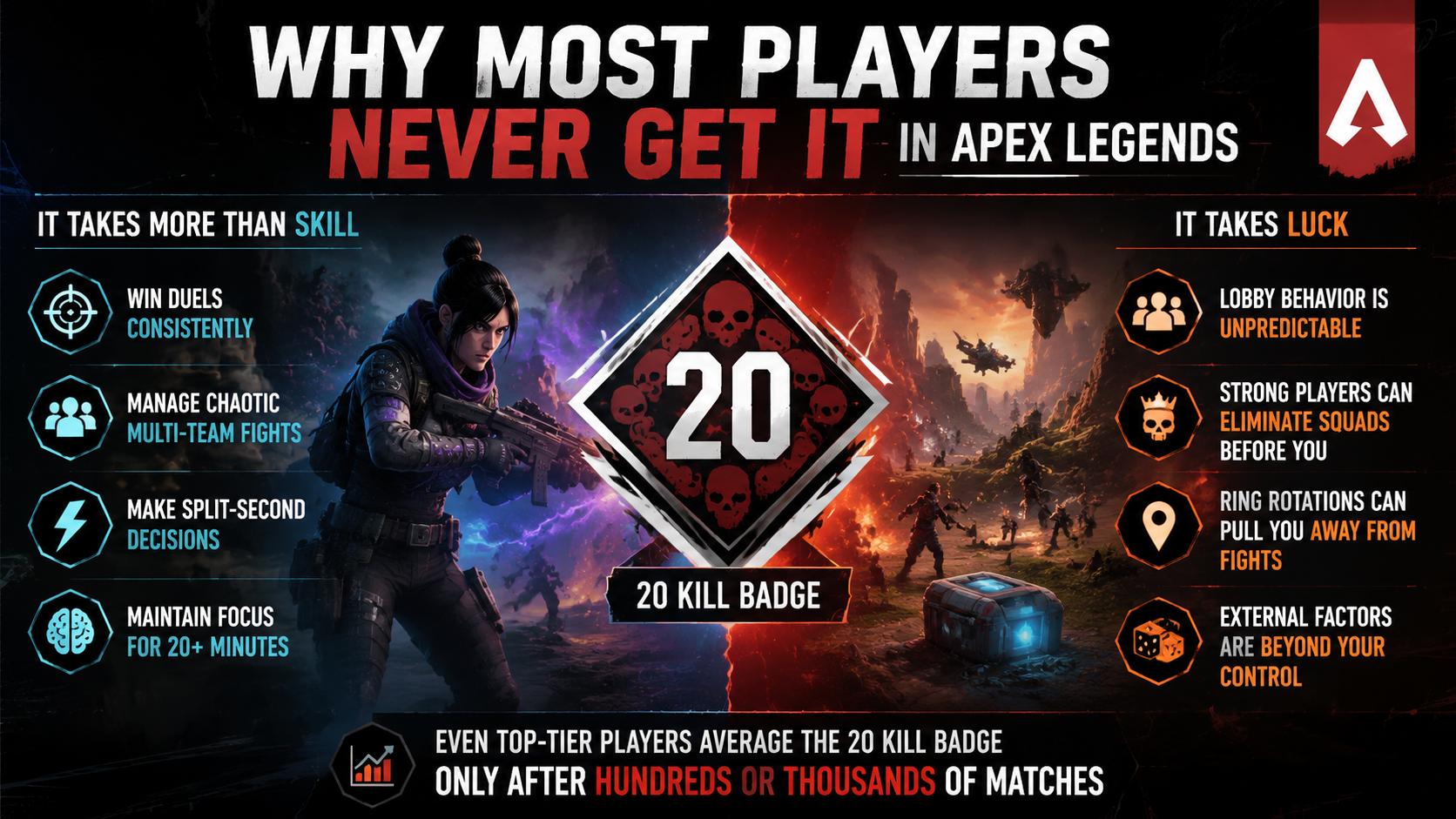
The rarity of the 20 Kill badge is not solely a matter of mechanical inability. The badge demands a convergence of multiple factors that most players cannot consistently control. The first factor is the skill ceiling. A player must win duels consistently, manage chaotic multi-team engagements, make split-second decisions under pressure, and maintain a high level of performance for the entire duration of a match that can last over twenty minutes. Even a brief lapse in concentration can result in elimination.
The second factor is luck. The behavior of the lobby is unpredictable. If teams spread out across the map and avoid early conflict, the total number of available kills shrinks. If strong players eliminate multiple squads before the badge seeker can engage them, potential kills disappear. If the ring forces rotations away from the player's position, they may miss entire fights. These external elements are beyond any player's direct influence. Statistically, even top-tier players average a 20 Kill badge only after hundreds or thousands of matches.
Apex Badge Boosting: Is It Worth It
Given the extreme difficulty and time investment required to earn the 20 Kill badge, some players consider external assistance through badge boosting services. These services involve playing alongside highly skilled players or having a professional player complete the challenge on the player's account. In a challenge where a significant portion of the difficulty stems not only from personal mechanics but also from favorable game tempo and lucky circumstances, some players conclude that boosting offers a practical shortcut. For those who have exhausted their own attempts or lack the time to invest hundreds of matches, an apex carry service provides an alternative path to acquiring the badge without the months of grinding that would otherwise be necessary. While opinions on boosting vary within the community, it remains a viable option for players seeking the badge without the full commitment of natural progression.
Final Thoughts
The 20 Kill badge remains one of the most formidable challenges Apex Legends has to offer. It requires a rare alignment of high-level mechanical skill, deep game knowledge, aggressive strategic execution, and favorable in-game circumstances. Even the best players must accept that the badge often comes down to factors beyond their control. For those who persist, every match becomes an opportunity to improve, observe, and refine the approach. Whether achieved through personal effort or alternative methods, the badge stands as a testament to a player's ability to dominate a lobby under the most demanding conditions.
The 20 Kill badge is one of the most demanding achievements in Apex Legends, requiring both high skill and favorable match conditions. Even experienced players may need dozens of attempts without success. Because of this, many players use carry or boosting services to unlock the badge more reliably.
Apex 20 Kill Badge Boost
Buy NowF.A.Q
1. What is the 20 Kill Badge in Apex Legends?
The 20 Kill Badge in Apex Legends is awarded for eliminating 20 enemies in a single match. It is one of the rarest and most skill-demanding achievements in the game.
2. How hard is it to get 20 kills in Apex Legends?
Getting 20 kills in Apex Legends is extremely difficult and requires both high skill and favorable match conditions. Most players need multiple attempts and optimized strategies.
3. What is the best strategy for 20 Kill Badge in Apex Legends?
The best strategy for the 20 Kill Badge is aggressive play, fast rotations, and constant engagement. Players must actively hunt enemies rather than play passively.
4. Which Legends are best for 20 Kill Badge in Apex?
The best legends for the 20 Kill Badge are high-mobility and aggressive characters that allow fast rotations and frequent fights. Mobility and survivability are key factors.
5. Can average players get the 20 Kill Badge in Apex Legends?
Most average players struggle to get the 20 Kill Badge without significant practice or optimized gameplay. The badge requires both mechanical skill and efficient decision-making.