Apex Legends Rank System Explained (RP, Tiers, Reset)

Understanding the ranked system in Apex Legends is fundamental for any player seeking to measure their skill and achieve consistent progression. This framework, built upon Rank Points (RP), divisions, and seasonal resets, governs the competitive landscape. A thorough comprehension of its mechanics separates those who climb efficiently from those who remain stagnant, regardless of raw mechanical ability.
How Ranked Mode Works in Apex Legends
Ranked Leagues represent the definitive competitive experience within Apex Legends, distinct from public matches through its structured progression system and stricter matchmaking. Every match influences a player’s standing, with performance directly translating into gains or losses of Rank Points. The primary objective extends beyond mere survival; it is a strategic pursuit of placement and measured combat to maximize RP accumulation over time, culminating in a visible rank that reflects both skill and game sense.
Understanding RP (Rank Points) in Apex Legends
Rank Points (RP) are the currency of progression. Their acquisition is determined by a combination of match placement and eliminations, with a critical escalating modifier for higher finishes. The system operates on a cost basis: each match requires an entry fee of RP, which varies by rank. To gain points, a player’s performance must exceed this cost.
Points are awarded as follows:
- Placement: The final standing of your squad provides a base RP reward, which increases dramatically for top placements (e.g., top 5, top 3, 1st place).
- Eliminations & Assists: Points are earned for kills and assists, but their value is multiplied by your placement tier. An elimination earned while finishing 10th yields fewer points than the same elimination earned while finishing 2nd. This design intentionally rewards strategic engagement and prioritizing survival over reckless early-game fights.
Therefore, consistent advancement requires a balance of tactical aggression and prudent positioning. A squad that achieves a high placement with few eliminations will typically gain more RP than a squad that secures several kills but dies early.
Every Rank and Tier in Apex Legends Explained
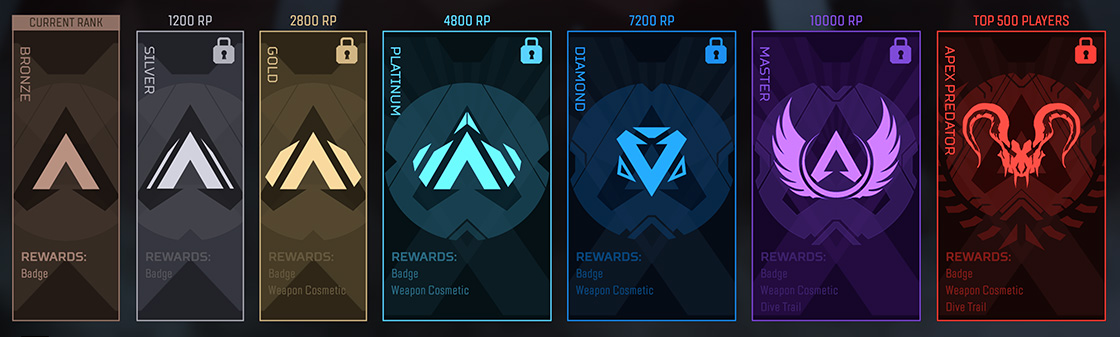
The ranked ladder is segmented into seven primary ranks, each with four subdivisions (e.g., Silver IV, Silver III, etc.), except for the apex tiers. Progress through each division requires accumulating 1000 RP.
- Rookie: An introductory rank with no entry cost, designed for new players to learn the ranked environment.
- Bronze: Features a minimal RP entry cost. Demotion to a lower rank is not possible here.
- Silver: The competition begins to intensify slightly. Players must start managing their entry costs versus gains.
- Gold: Represents the median skill level. Team coordination and basic macro-strategy become necessary for consistent gains.
- Platinum: A significant difficulty increase. Players encounter disciplined opponents, and poor decision-making is consistently punished. Solo progression becomes notably more challenging.
- Diamond: The threshold for advanced play. Masters and Predator-level players frequently appear in these lobbies. Excellence in positioning, rotation, and combat efficiency is mandatory.
- Master & Apex Predator: The highest echelons. Master is achieved upon reaching a set RP threshold (e.g., 15,000 RP). Apex Predator comprises the top 750 players per platform within the Master tier, requiring constant RP maintenance to remain.
Seasonal Rank Reset in Apex Legends
At the conclusion of each ranked series, a soft reset occurs. All players are demoted by approximately 1.5 ranks from their peak. For example, a Diamond II player might reset to Gold II. This mechanism serves crucial purposes: it prevents rank inflation, ensures every new season presents a fresh climb, and temporarily consolidates the player population for healthier matchmaking at the season’s start. It is a recalibration, not a punishment.
What Really Helps You Rank Up in Apex Legends
Sustainable progression is built upon pillars beyond aim:
- Rotation and Positioning: Securing advantageous zone positions early eliminates the need for risky late-game rotations through contested territory.
- Damage Mitigation: Winning ranked matches is about effective hitpoint management. Choosing engagements wisely to preserve team resources is more valuable than forcing every possible fight.
- Elimination Selection: Understanding when to third-party a distant fight, when to disengage from a prolonged battle, and when to hold a position is critical.
- Loadout and Legend Synergy: Building a team composition with complementary abilities and ensuring reliable, ammo-efficient weapon loadouts tailored to the match’s phases.
Common Ranked Mistakes in Apex Legends
Recurring errors that hinder progression include:
- Over-prioritizing Kills: Dropping onto a crowded hotspot for early eliminations is a high-variance strategy. Early elimination often results in a significant RP deficit.
- Passive Play in Late Game: Conversely, avoiding all combat until the final circles leaves a team under-geared and lacking the placement-multiplied elimination RP necessary for major gains.
- Ignoring the Ring: Underestimating the damage of later ring closures leads to catastrophic losses and wasted RP.
- Lack of Team Cohesion: Splitting from the squad, looting excessively during critical phases, or pursuing individual fights without team support drastically reduces survival odds.
Should You Solo Queue or Play in a Squad?

The choice significantly impacts the climb. Solo queueing relies on adapting to random teammates’ playstyles and communicating effectively via pings and voice. Consistency can be challenging due to variable team cohesion. A pre-made squad with dedicated roles and practiced strategies offers superior coordination, predictable rotations, and generally more stable RP gains. For players aiming for Platinum and beyond, a reliable squad is highly recommended, though mastering adaptability is essential for solo play.
Reaching Your Ranked Goals
Achieving a target rank is a function of applied knowledge, deliberate practice, and time investment. Analyzing gameplay to correct recurring mistakes is essential. While some players may utilize Apex Legends Rank Boosting services to expedite the acquisition of seasonal rewards or a specific rank badge, a genuine and lasting understanding of the RP system, map meta, and team dynamics remains the sole foundation for long-term improvement and consistent competitive performance.
F.A.Q
1. What exactly is RP and how is it calculated?
RP, or Ranked Points, is the numerical currency used to measure your rank progression. At the start of each match, you pay an entry cost based on your current tier. The entry cost for Rookie and Bronze is zero, Silver costs 12 RP, Gold costs 24 RP, Platinum costs 36 RP, Diamond costs 48 RP, Master costs 60 RP, and Apex Predator costs 60 RP as well. After the match concludes, you receive RP for two components: placement points and elimination points. Placement points are awarded based on your team’s final position: first place grants 100 placement points, second place grants 60, third place grants 40, and so on down to thirteenth place which grants zero. Elimination points are capped: each elimination awards 10 RP, but the total elimination RP your team can earn is limited to the sum of your squad’s entry cost. For example, if your entire squad pays a combined 120 RP entry cost, you can earn up to 120 RP from eliminations. The total RP earned is therefore the sum of placement points plus capped elimination points, minus the entry cost. Displayed as net change, this value determines whether you move up, stay, or drop within your division.
2. How does the seasonal rank reset work?
At the end of each season, which spans two splits, Apex Legends performs a full soft reset. Your final rank determines your starting point for the next season. Players finishing in Rookie or Bronze begin the next season in Rookie 4. Players finishing in Silver start in Bronze 2. Those finishing in Gold start in Silver 2. Platinum finishers start in Gold 2. Diamond finishers start in Platinum 2. Master and Apex Predator players start in Platinum 2. Additionally, during the mid-season split, a partial reset occurs: your rank is rolled back by six divisions, but your MMR (Matchmaking Rating) carries over more substantially to ensure you face appropriately skilled opponents despite your visible rank dropping. Importantly, your highest achieved rank in any split determines the end-of-season rewards you receive, including dive trails, badges, and gun charms.
3. What is the difference between RP and MMR?
RP is your visible, tier-based rank that you see on your profile and in the lobby. MMR, or Matchmaking Rating, is an invisible behind-the-scenes value that the matchmaking system uses to find opponents of similar skill. RP dictates which tier and division you belong to publicly, while MMR ensures that even if you fall to a lower RP tier, you still face players of your actual skill level. This prevents high-skill players from dominating lower-ranked lobbies after a season reset. MMR is adjusted more aggressively than RP and is based on a wider set of performance metrics, including damage dealt, assists, survival time, and consistency across matches. The system prioritizes MMR over RP when forming lobbies, meaning two players with the same RP but drastically different MMRs will rarely face each other.
4. What really helps you rank up effectively?
Ranking up effectively requires a combination of strategic decision-making, consistent performance, and adaptive teamwork. First, prioritize survival. Since placement points significantly outweigh elimination points in the RP formula, reaching the final circles consistently is more important than chasing high kill counts. Second, communicate clearly with your team. Use voice chat or ping systems to coordinate rotations, call out enemy positions, and decide when to engage or disengage. Third, choose a landing spot that balances loot quality with early-game safety. Hot-dropping into heavily contested areas may result in quick eliminations and lost RP; instead, land at medium-density zones with good loot and manageable contest risk. Fourth, manage your inventory efficiently. Always carry at least two stacks of healing items and one shield battery. Fifth, master one or two legends per role: a movement legend for rotations, a defensive legend for holding positions, and an offensive legend for third-party engagements. Finally, review your gameplay. Recording and analyzing your matches helps identify recurring mistakes such as poor positioning, failing to rotate early, or engaging in lost fights.
5. What are the most common ranked mistakes players make?
The most frequent mistake is overcommitting to fights that yield minimal RP value. Players often chase elimination badges or engage every fight they hear, even when no third-party risk assessment has been performed. This leads to early death and significant RP loss. Another common error is poor rotation timing. Many players wait too long before moving to the next ring, forcing them to traverse open ground while being shot at by multiple teams. A third mistake is ignoring the kill cap. Players may secure multiple kills early but then continue fighting beyond the cap, gaining no additional RP while risking their placement points. A fourth issue is inadequate team cohesion. Solo players without microphones often fail to share loot, ping enemy locations, or synchronize ultimate abilities. Finally, many players neglect to adjust their playstyle based on their current RP tier. Playing a Platinum match the same way you played Silver results in consistent underperformance.
6. How do seasonal splits work and do I need to rank up twice?
Each Apex Legends season is divided into two splits, each lasting approximately six weeks. Your rank is partially reset at the start of Split 2, dropping you by six divisions from your Split 1 final rank. You need to rank up again during Split 2 to reach your desired final tier. Importantly, your end-of-season rewards are based on your highest achieved rank across either split, not the average. For instance, if you reach Diamond in Split 1 but only Platinum in Split 2, you still receive Diamond rewards. This means you only need to achieve your target rank once per season to earn the associated rewards. However, reaching the Apex Predator tier requires both high skill and continuous play, as the top 750 players per platform are determined by RP totals, which reset each split.
10. What tier should I aim for as a new ranked player?
A new ranked player should set a realistic initial target of Gold or Platinum. This is achievable with basic game knowledge, consistent rotations, and an average positive RP gain per match. Silver and below are forgiving tiers with zero entry cost, allowing you to learn without penalty. Gold introduces entry costs and requires you to earn at least 24 RP per match to maintain your rank. Platinum places you in the top 30 percent of the player base and demands strong decision-making and mechanical skill. Avoid rushing to Diamond or Master without first mastering the fundamentals at lower tiers. A structured progression path: reach Silver in your first split, Gold in your second, Platinum by your third season, and Diamond only after you consistently maintain a 1.5 KDA in Platinum lobbies. Rushing into higher tiers prematurely results in repeated demotion and frustration.