Overwatch Ranking System: How SR and MMR Work
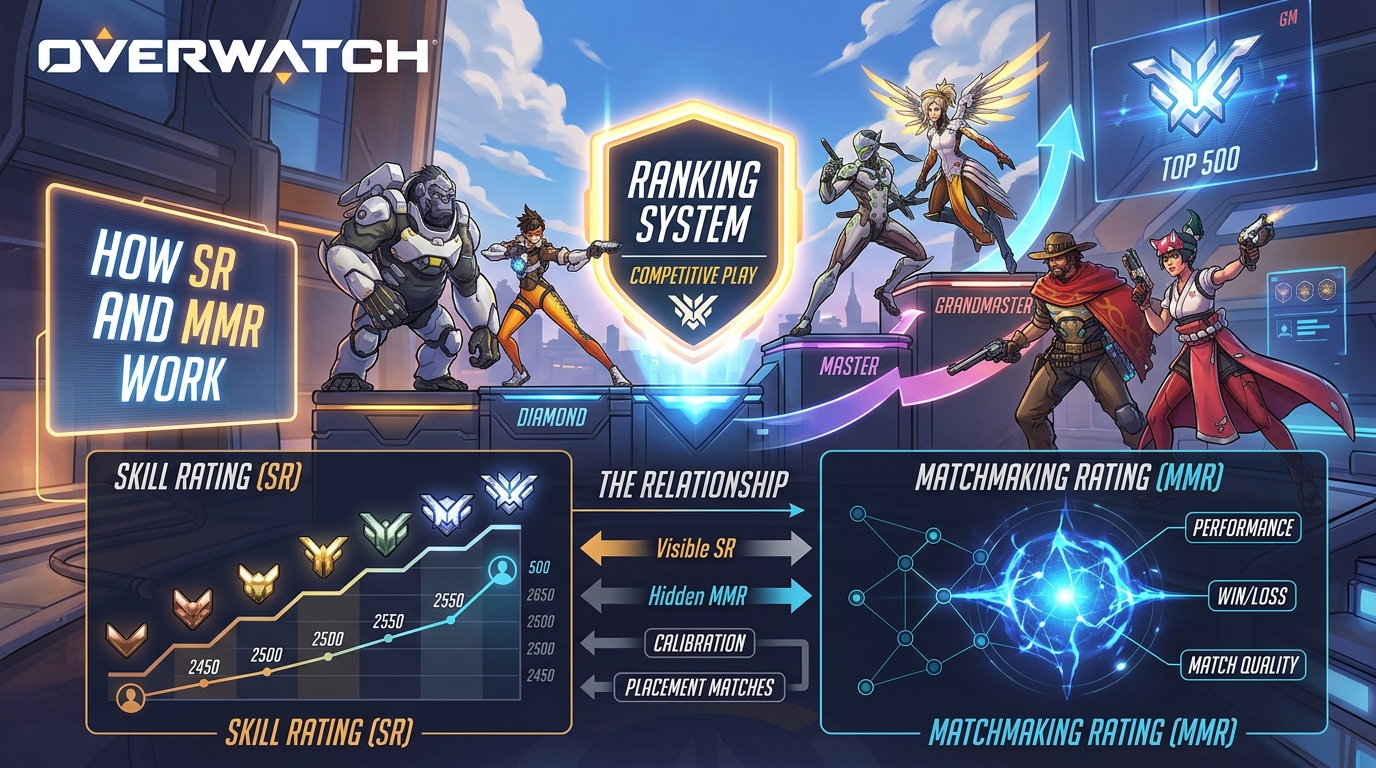
Ranking up in Overwatch often feels confusing because players do not fully understand how SR changes after matches. The Overwatch ranking system is based on SR (Skill Rating) and MMR (Matchmaking Rating), which determine your rank and match quality. Understanding how these values interact helps players climb more consistently and avoid frustrating rank drops.
What Is SR and MMR in Overwatch
The game uses two distinct metrics to evaluate player performance, and they do not always align visually. The relationship between overwatch sr and overwatch mmr defines how fast a player progresses through the ladder.
- SR (Skill Rating): This is the visible numerical score displayed on the player profile. SR directly determines which rank tier a player occupies. A win increases SR, a loss decreases it. The visible number is what players see after each match.
- MMR (Matchmaking Rating): This is a hidden internal value that the matchmaking system uses to assess true player skill. MMR considers long-term performance, consistency, individual statistics, and the quality of opponents faced. The system uses MMR to find balanced matches and to determine how much SR is gained or lost after each game.
The critical distinction is that SR updates immediately after each match, while MMR adjusts more slowly based on sustained performance. A player with high MMR but low SR will gain more SR per win and lose less per loss until the two values converge.
How Ranking System Works in Overwatch
The overwatch ranking system evaluates matches by comparing the expected outcome against the actual result. Before a game begins, the system calculates each team's average MMR. If Team A has a significantly higher average MMR than Team B, the system expects Team A to win. If Team A wins, SR gains are modest because the result was predicted. If Team B wins, SR gains for Team B are large, and SR losses for Team A are severe.
Individual performance is also factored into SR adjustments. The system tracks statistics such as eliminations, deaths, damage dealt, healing output, objective time, and ultimate usage. These metrics are compared against averages for the same hero at the same rank. Players who perform well above the average in a loss lose less SR than teammates who performed poorly. Conversely, a player carried in a win gains less SR than the top performer.
This design ensures that over dozens of matches, SR converges toward the player's true skill level. Short-term variance from bad teammates or unlucky streaks is smoothed out by volume.
Role Queue and Its Impact in Overwatch
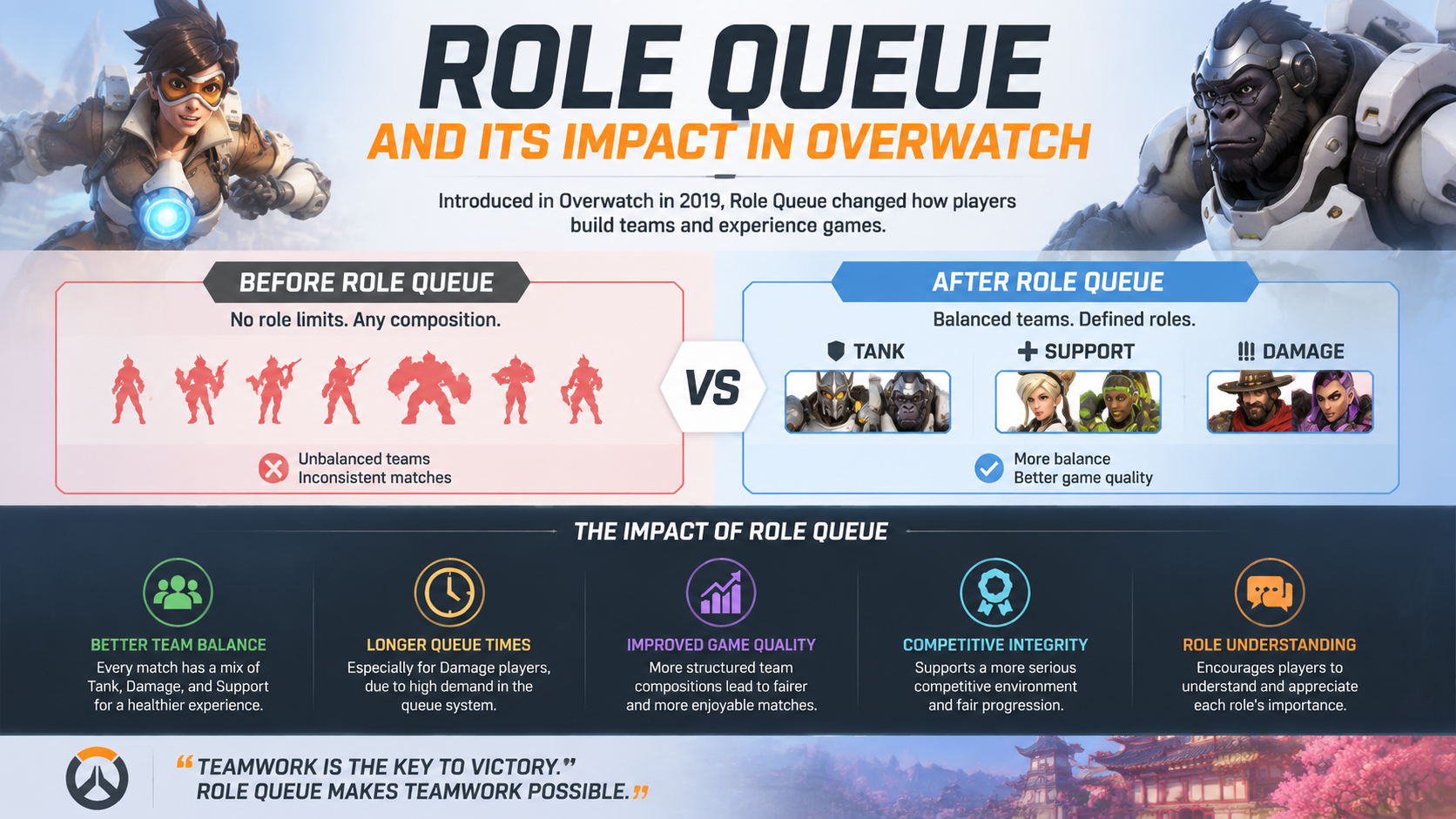
The overwatch role queue system assigns separate SR and separate MMR for each role: Tank, Damage, and Support. A player might have a Diamond rank on Tank but a Platinum rank on Damage and Support. This separation exists because the skills required for each role differ significantly.
Role queue impacts rank progression in two ways. First, queue times vary by role. Damage players often wait longer for matches due to higher popularity, which can slow the pace of climbing. Tank and Support players generally find matches faster. Second, the influence of each role on match outcome differs. A strong Tank creates space and enables the team. A strong Support sustains the team through pressure. A strong Damage player secures eliminations. Because each role contributes differently, climbing speed can vary even if the player's skill is equal across all three roles.
What Affects Your Rank in Overwatch
Several factors beyond simple win-loss records determine how the overwatch rank changes over time.
- Wins: Wins are the primary driver of SR gain. However, the amount of SR gained depends on the strength of the opponent and the margin of victory. A close win against a weaker team yields less SR than a decisive win against a stronger team.
- Individual performance: The system compares each player's statistics against the average performance of that hero at that rank over the past weeks. Stat lines above the average result in bonus SR. Stat lines below the average reduce SR gain or increase SR loss. Key metrics include eliminations per life, damage per minute, healing per minute, and objective contributions.
- Consistency: Players who maintain stable performance across many matches achieve more predictable SR changes. Erratic play with very high highs and very low lows confuses the MMR model, causing slower convergence toward the correct rank. Steady play signals reliability to the system.
Rank Tiers in Overwatch Explained
The overwatch ranks form a structured ladder from beginner to elite. Each tier represents a distinct skill bracket.
- Bronze (SR 1–1499): Players at this level demonstrate basic understanding of mechanics but struggle with positioning, ability usage, and game sense.
- Silver (SR 1500–1999): Players show improved mechanical consistency but still make frequent errors in team coordination and map awareness.
- Gold (SR 2000–2499): The average player base resides here. Gold players understand core strategies but lack the precision and discipline of higher tiers.
- Platinum (SR 2500–2999): Players display solid mechanics and good game sense. Team coordination is more consistent, and individual mistakes are less frequent.
- Diamond (SR 3000–3499): Mechanical skill and game sense are strong. Players at this rank understand advanced positioning and cooldown management.
- Master (SR 3500–3999): Players demonstrate near-professional level mechanics and deep game knowledge. Team play is highly coordinated.
- Grandmaster (SR 4000+): The highest achievable rank. Players exhibit elite mechanical skill, rapid decision-making, and complete mastery of their heroes and team compositions.
Why Ranking Up in Overwatch Feels Random
Many players experience frustration when overwatch matchmaking produces games that feel imbalanced or when SR changes seem unpredictable.
- Team dependency: Each match involves nine other players. One player's performance is only one variable among ten. A strong individual performance can be undermined by poor team coordination, composition disadvantages, or an opposing team that simply outplays. The system cannot isolate individual contribution from team outcome perfectly.
- MMR disparities: The matchmaker attempts to balance teams within a certain tolerance. However, wide skill gaps between players in the same match are possible, especially at off-peak hours or in less populated rank tiers. This creates games where one team dominates, leading to frustrating losses that feel outside the player's control.
Understanding that rank fluctuations are a normal feature of the system helps reduce emotional tilt. The ranking system is designed to reward sustained performance over many games, not individual match results.
Best Strategies to Climb Rank in Overwatch
Effective how to rank up in overwatch strategies focus on consistency, hero mastery, and mental discipline.
- Limit hero pool: Focus on one or two heroes per role. Mastery of a small hero pool allows deeper understanding of matchups, cooldown management, and positioning. Switching heroes every match prevents skill development.
- Avoid tilt: Emotional frustration directly impairs decision-making. Tilt leads to overextending, poor ability usage, and reduced communication. Recognizing when tilt sets in and taking a break prevents downward spirals of consecutive losses.
- Review gameplay: Recording and reviewing matches reveals mistakes invisible during gameplay. Positioning errors, missed abilities, and poor ultimate timing become clear. Correlating specific mistakes to lost games accelerates learning.
- Communicate effectively: Shotcalling, tracking enemy ultimates, and coordinating ability usage increases win probability. Even simple callouts provide value.
Rank Boosting in Overwatch
For players who struggle to climb due to time constraints or persistent performance barriers, overwatch rank boost services exist as an external option. Overwatch boosting involves a highly skilled player logging into the client to play ranked matches on behalf of the account, directly increasing SR to a target rank. Boosting bypasses the natural in-game progression system entirely. The service exists because the ranking system demands many hours of play to reflect true skill, and some players prefer immediate access to higher-tier matches. While boosting does not replace personal skill development, it provides a shortcut for players who value rank over the learning process. Players considering such services should verify provider legitimacy and understand the account security risks involved.
Understanding SR and MMR is key to making sense of your rank progression in Overwatch. Players who ignore these mechanics often feel stuck, even when their gameplay improves. To climb more efficiently, some players turn to coaching or boosting services to better navigate the ranking system.
Overwatch Rank Boosting
Buy NowF.A.Q
1. How does the ranking system work in Overwatch?
The Overwatch ranking system uses MMR (Matchmaking Rating) and performance data to determine player rank. Wins, losses, and individual impact all influence ranking.
2. What is MMR in Overwatch?
MMR in Overwatch is a hidden rating that determines matchmaking and rank progression. It reflects a player's true skill level beyond visible rank.
3. Can I lose rank in Overwatch?
Yes, players can lose rank in Overwatch after consecutive losses or poor performance. Rank reflects both results and consistency.
4. Why does my rank not change after wins?
Rank changes in Overwatch may be small or delayed if MMR and visible rank are not aligned. The system adjusts gradually based on performance trends.
5. What is the fastest way to rank up in Overwatch?
The fastest way to rank up in Overwatch is to maintain consistent performance, focus on team play, and minimize mistakes during matches.