Fortnite Ranking System: Ranks, Progression, and Rewards
The fortnite ranking system is a structured competitive framework that evaluates player skill through a combination of placement, eliminations, and survival. Many players perceive rank progression as random or inconsistent. In reality, the system follows a precise mathematical model that rewards specific behaviors while penalizing others. Understanding this model transforms rank climbing from a frustrating gamble into a predictable process. This article examines the mechanics, common misconceptions, and practical strategies for stable rank growth.
What Is Fortnite Ranked Mode
Fortnite ranked is a competitive mode where players compete for rating points based on match performance. The fortnite ranking system uses a dynamic matchmaking algorithm that pairs players of similar skill levels. Unlike standard battle royale matches, ranked mode tracks every action and assigns point values accordingly. Competitive mode requires a different mindset: survival matters more than highlight plays. Matchmaking adjusts after each game, placing winners against stronger opponents and losers against weaker ones. This ensures that rank reflects actual skill rather than luck.
Fortnite Ranks Explained (Full List)
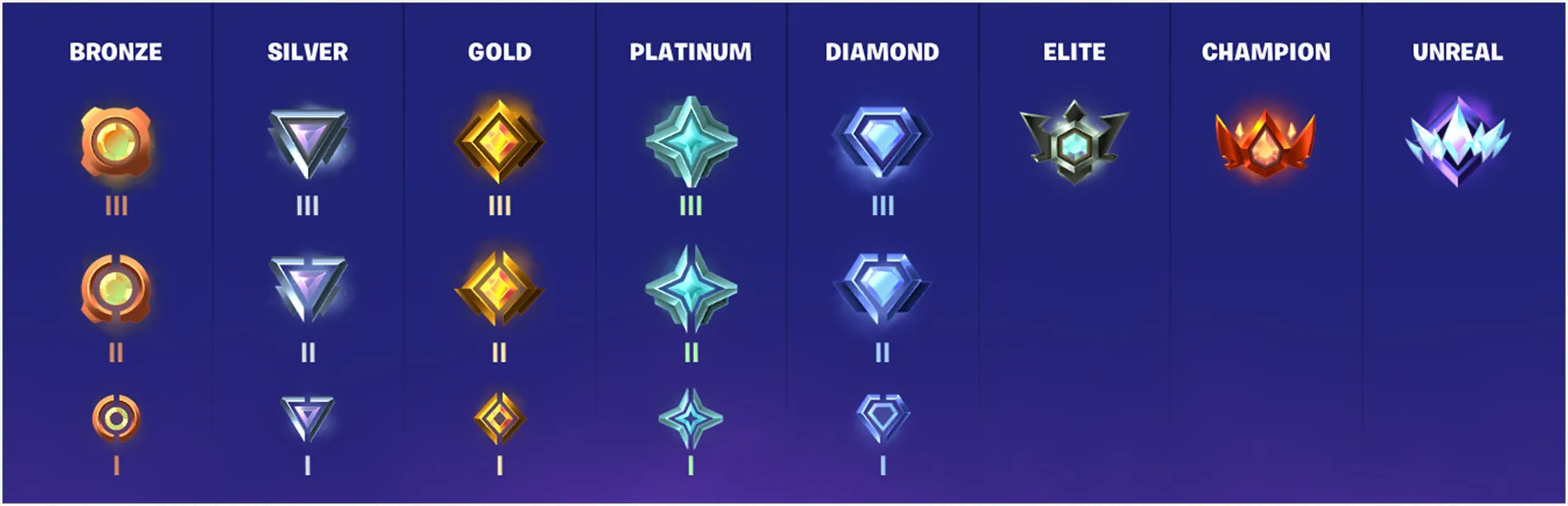
The fortnite ranks system consists of eight major tiers, each divided into three sub-ranks except for the top two. The fortnite rank list from lowest to highest is:
- Bronze (I, II, III)
- Silver (I, II, III)
- Gold (I, II, III)
- Platinum (I, II, III)
- Diamond (I, II, III)
- Elite (single rank)
- Champion (single rank)
- Unreal (single rank, highest)

Bronze Division
Player representation: Approximately 21 percent of all ranked participants.
Tier structure: Bronze I, Bronze II, and Bronze III.
Bronze serves as the entry point for individuals new to competitive gameplay. The majority of matches in this division feature participants who are still acquiring foundational abilities such as constructing under duress, executing rotation timing, and managing inventory. The range of skill levels is considerable; some Bronze players are entirely inexperienced, whereas others are reascending following seasonal rank resets.
Methodology for advancing beyond Bronze: Prioritize consistent placement within the top ten positions rather than pursuing every elimination opportunity. Master fundamental building techniques, including box fighting and simple high-ground acquisition. Survey the map to identify secure rotation pathways and zones with abundant loot. Refrain from landing at high-traffic areas unless one is proficient in early engagement combat.

Silver Division
Player representation: Approximately 30 percent of all ranked participants, making it the most densely populated division.
Tier structure: Silver I, Silver II, and Silver III.
Silver I constitutes the single most prevalent rank within Fortnite, accommodating roughly 9.9 percent of the entire ranked player base. Participants in Silver possess a grasp of basic mechanics but encounter challenges with consistency. Observable behaviors include competent building, tactical awareness, and deliberate loadout selections; however, errors remain frequent.
Differentiating factors between Silver and Gold: Material management—depleting resources during combat is a common occurrence in Silver but is seldom observed in Gold. Editing speed—Silver players can perform edits but often exhibit hesitation; Gold players execute edit sequences with fluidity. Endgame positioning—comprehension of zone rotations before their closure becomes a critical skill.

Gold Division
Player representation: Approximately 23 percent of all ranked participants.
Tier structure: Gold I, Gold II, and Gold III.
Gold signifies the transition from casual competitive play to serious ranked engagement. Participants at this level demonstrate solid game sense, familiarity with meta loadouts, and a low frequency of unforced errors. The intensity of competition heightens considerably; every player possesses the ability to build, edit, and apply pressure effectively.
Challenges associated with the Gold plateau: Many players become stationary between Gold II and Gold III due to the steep skill elevation required for Platinum. Third-party interference becomes a regular occurrence; adept players capitalize on ongoing skirmishes. Zone awareness emerges as more consequential than mechanical proficiency at this tier.

Platinum Division
Player representation: Approximately 14 percent of all ranked participants.
Tier structure: Platinum I, Platinum II, and Platinum III.
Platinum players exhibit mechanical competence and tactical precision. Opponents demonstrate efficiency in box fighting, execute calculated aggressive maneuvers, and exploit positioning errors without hesitation. Attaining Platinum positions a player within the top 25 percent of the ranked population.
Requirements for ascending beyond Platinum: Advanced building and editing skills, including triple edits, rapid resets, and creative high-ground recapture techniques. Optimal loadout configuration, encompassing knowledge of weapon prioritization and timely swaps. Endgame intelligence, including storm surge understanding, positioning for rotating zones, and discernment of when to disengage.

Diamond Division
Player representation: Approximately 8 percent of all ranked participants.
Tier structure: Diamond I, Diamond II, and Diamond III.
Diamond represents high-level competitive play. Participants have accumulated thousands of hours of experience and treat ranked matches as tournament practice. Reaching Diamond I establishes a player within the top 13 percent globally. Opponents aggressively control piece placement, instantly punish peeking mistakes, and analyze movement patterns.
Characteristics of Diamond gameplay: Lightning-fast edits and resets during building engagements. Strategic employment of utility items, such as shock grenades and crash pads, to execute outplays. Discipline in avoiding unnecessary confrontations that deplete resources.

Elite Division
Player representation: Approximately 2 percent of all ranked participants.
Division structure: Single tier without subdivisions.
Elite is the domain of serious competitors. This rank demands consistent top-tier performance across numerous matches. Upon reaching Elite, a player cannot be demoted for the remainder of the season; the rank is locked irrespective of subsequent performance.
Qualification prerequisites for Elite: Exceptional mechanical skill and comprehensive game sense. Capability to win engagements while preserving materials and health. Discernment of when to adopt an aggressive approach (W-key) versus a passive strategy.

Champion Division
Player representation: Approximately 1 percent of all ranked participants.
Division structure: Single tier without subdivisions.
Champion players possess tournament-caliber abilities. Many have participated in FNCS qualifiers or Cash Cups. Similar to Elite, the Champion rank is permanent once achieved during a season. Achieving this tier frequently necessitates collaboration with a consistent duo or trio that understands competitive meta strategies.
Differentiating factors between Champion and Elite: Consistent ability to secure top-five placement in densely populated lobbies. Mastery of midgame rotation and zone control. Comprehension of point-based gameplay within tournament-style scoring systems.

Unreal Division
Player representation:
Less than 0.5 percent of all ranked participants.
Division structure: Single tier without subdivisions; represents the highest achievable rank.
Unreal constitutes the pinnacle of Fortnite ranking. Only the most exceptional players attain this tier, representing the top 0.5 percent globally. Unreal participants frequently engage in streaming, professional competition, or have dedicated thousands of hours to perfecting their craft. Once Unreal rank is achieved, it remains locked for the entire season, and players qualify for major competitive events.
Current requirements for Unreal: Attainment of this rank must occur before specific tournament deadlines to qualify for events such as the Unreal Cup. Comprehensive mastery of every game mechanic and deep knowledge of the meta. Typically achieved by players with over 3,000 hours of competitive Fortnite experience.
How Ranked Points Work
Fortnite rank points are the currency of progression. Points are gained or lost after each match based on three primary factors. How fortnite ranking works centers on the balance between placement and eliminations.
Placement awards points for survival. Reaching top twenty-five gives a small bonus. Top ten provides a moderate boost. Top five and victory royale grant substantial point gains. Placement rewards are higher in higher ranks, encouraging survival play.
Kills add points but with diminishing returns. The first elimination provides the largest bonus. Subsequent kills add smaller increments. This prevents farming eliminations from becoming the primary strategy.
Survival time is tracked but not explicitly displayed. Surviving longer without engagements grants passive points. Dying early with zero eliminations results in significant point loss.
The kills and placement interaction is critical. A player who places second with zero kills earns more points than a player who places thirtieth with ten kills. The points system prioritizes survival over aggression.
What Affects Your Rank Progression
Multiple factors determine how quickly rank increases. Players who complete the same number of matches often reach different ranks due to these variables.
- Stability: Consistent top-ten finishes with one to two eliminations per match produce steady rank growth. Sporadic victories followed by early deaths create net zero or negative progression.
- K/D (kill/death ratio): This metric reflects combat efficiency. A K/D above two indicates winning more engagements than losing. Higher K/D correlates with faster rank advancement because it combines survival with elimination bonuses.
- Late game performance: Performance in top-ten and top-five situations carries disproportionate weight. Points awarded in final circles are multiplied. Players who choke in late game lose potential gains even if they played well earlier.
Rank Reset and Seasons
Fortnite operates on seasonal cycles. Each season concludes with a rank reset. The reset does not return players to Bronze. Instead, it drops most players by approximately one full tier. A Champion player might restart at Diamond III. A Platinum player might return to Gold I.
This partial reset serves two purposes. First, it prevents permanent rank inflation. Second, it creates a competitive shakeup at the start of each season. After reset, matchmaking becomes temporarily unstable. Players who were previously separated by rank now compete in the same lobbies. This period requires patience and adjusted expectations. Progress during the first week after reset often feels slower due to higher concentration of skilled players in mid-tiers.
Why Ranking Up Gets Hard
As rank increases, progression predictably slows. Several structural reasons explain this phenomenon.
- Skill ceiling: At higher ranks, player skill differences shrink. Every opponent has mastered basic mechanics. Winning requires marginal advantages rather than clear superiority. The skill ceiling means that natural talent alone cannot guarantee rank advancement.
- RNG / unpredictability: Random factors influence every match. Loot distribution, storm circles, and opponent behavior create variability. A perfectly played match can end in early death due to bad zone luck. Higher ranks amplify the impact of randomness because mistakes are punished more severely.
- Teammates: In team modes, random teammates introduce inconsistency. Poor communication, different playstyles, or lack of coordination can sabotage otherwise strong individual performance. Solo queuing adds a layer of uncertainty that affects rank progression speed.
How Players Actually Climb Faster
Practical strategies derived from the ranking system logic produce reliable results. These recommendations focus on gameplay adjustments rather than abstract advice.
- Play for placement: Prioritize reaching top ten in every match. This provides a baseline of positive point gain. Even without eliminations, consistent top-ten finishes result in steady rank advancement over dozens of matches.
- Avoid early fights: Engaging opponents in the first two minutes of a match carries high risk with low reward. Early eliminations yield minimal points. Dying early costs significant points. Land in less contested areas, loot efficiently, and rotate toward the circle.
- Take correct zones: Study storm rotations and occupy advantageous positions before the final circles close. High ground, natural cover, and zone prediction give significant late game advantages. Players who master zone control consistently outperform those who rely on reaction.
Rank Boosting in Fortnite: Why Players Use It
Some players consider boosting services to overcome obstacles on the way to progress. This decision is often driven by legitimate constraints rather than a lack of skills.
- Time: Reaching Champion or Unreal rank requires dozens of hours per season. Players with limited gaming time may not have the capacity to grind through lower tiers repeatedly.
- Difficulty: The skill jump between Platinum and Diamond, and again between Diamond and Elite, is substantial. Without dedicated practice, progress stalls. Experienced players understand that mechanics alone are insufficient.
- Unstable matches: Team-based ranked play introduces variability beyond individual control. Random teammates, communication failures, and coordination gaps create unpredictable results. This instability frustrates players who perform well individually but cannot consistently win matches.
Understanding the ranking system removes the mystery from progression. Players who apply placement-focused strategies, avoid unnecessary risks, and maintain consistent performance will see steady rank growth. Those who ignore system mechanics will find progress slow and frustrating regardless of mechanical skill.
Fortnite Rank Boost – Achieve Your Desired Rank
Buy NowF.A.Q
1. How does Fortnite ranking system work?
The Fortnite ranking system is based on performance metrics such as eliminations, placement, and match consistency. Players gain or lose rank points depending on their in-game performance relative to other players.
2. What gives the most rank points in Fortnite?
The most rank points in Fortnite come from a combination of high placement and eliminations. Balanced performance is more effective than focusing only on kills or survival.
3 . Why is ranking up in Fortnite difficult?
Ranking up in Fortnite is difficult because the system rewards consistency and punishes mistakes. As rank increases, opponents become stronger, making progression slower.
4. Why do I lose Fortnite rank quickly?
Players can lose rank in Fortnite if their performance is below average. Poor placement and low eliminations typically result in rank point loss.
5. What is the fastest way to rank up in Fortnite?
The fastest way to rank up in Fortnite is to maintain consistent top placements while securing eliminations. Smart rotations and avoiding early eliminations are key factors.
6. What is the highest rank in Fortnite?
The highest rank in Fortnite is Unreal, which represents the top competitive tier in the ranking system. Players in Unreal rank compete against the strongest opponents, and progression beyond this point is based on leaderboard position rather than traditional rank tiers.
7. How can boosting help with Fortnite rank?
Boosting can help improve Fortnite rank by increasing win rate, match consistency, and overall performance in ranked games. It is typically used by players who want to reach higher ranks faster when facing strong competition or limited time for grinding.